
Home / Guides / Ceramic coating or PPF
Guide · Paint protection & coating Ceramic coating or PPF – what do I really need?
Most questions about paint protection start with “Which is better?”. The more honest question is: what do you want to protect your paint against – and do you need anything for that at all?
Ceramic coating and paint protection film are often compared as if they were two levels of the same service. They are not. How we carry out both is described on our pages about ceramic coating and paint protection film. This page is about the question that comes first: do you need one of them – and if so, which one?
In short
A ceramic coating makes your paint easier to maintain. It does not prevent stone chips, though. A paint protection film absorbs mechanical stress such as stone chips, but involves considerably more work. If your main problem is maintenance, you do not need film. If your main problem is stone chips, ceramic alone will not satisfy you. And if you drive little and wash carefully by hand, you may need neither.
Two systems, two jobs
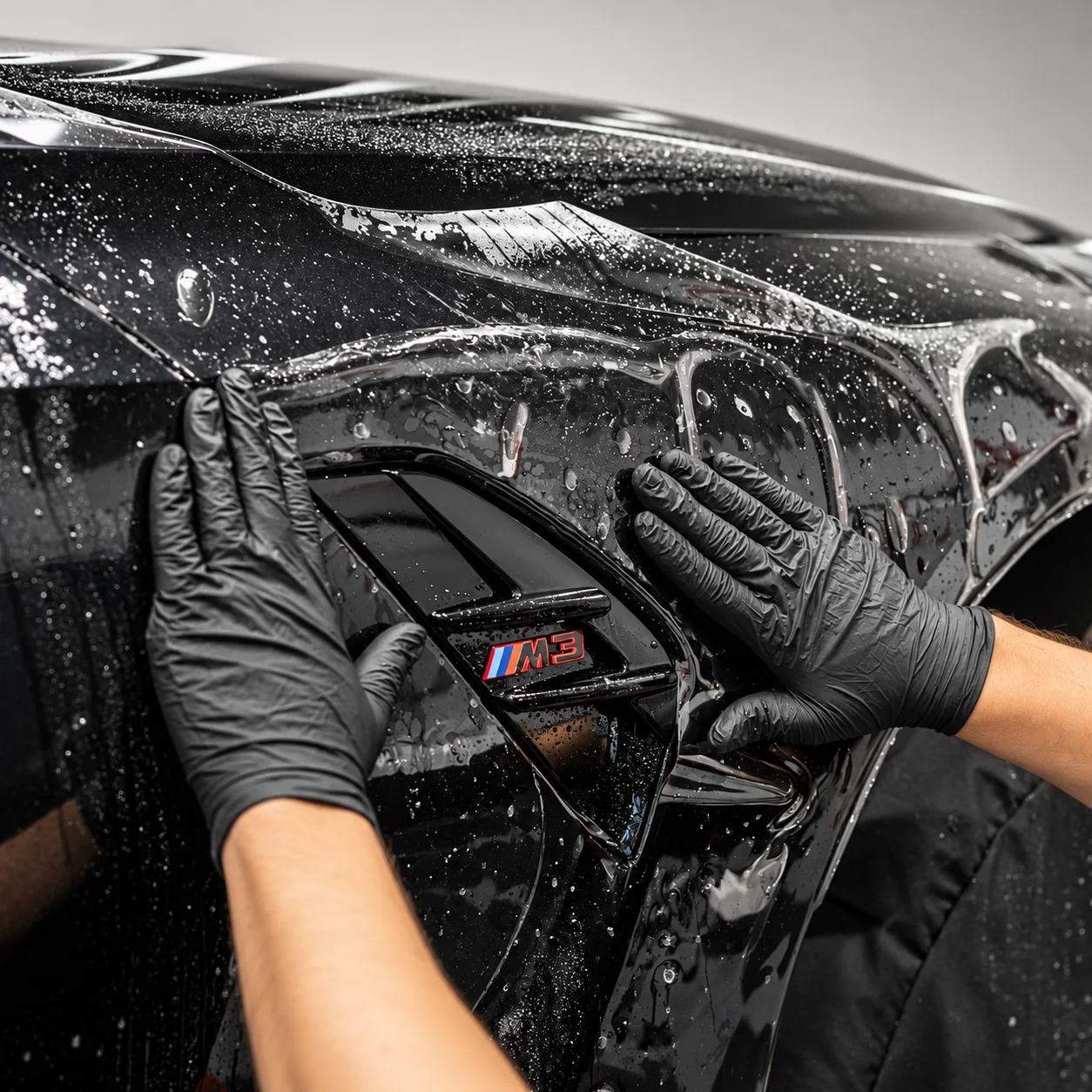
Automotive paint consists of several layers. The top one, the clear coat, is usually only about 30 to 50 micrometres thick and does not grow back – every polish removes some of it. A ceramic coating forms a very thin, hard, glass-like layer on top that is harder than classic polymer sealants. A paint protection film, by contrast, is a material of its own based on polyurethane. The manufacturers SunTek, XPEL and Profilm state total thicknesses of about 170 to around 240 micrometres for their films, depending on the product. So the film is thicker than the entire clear coat. That very mass is the reason why film can absorb stone chips and a coating cannot.
| Ceramic coating | Paint protection film (PPF) | |
|---|---|---|
| Main job | Easier care, protection against environmental influences and dirt | Mechanical protection of exposed surfaces |
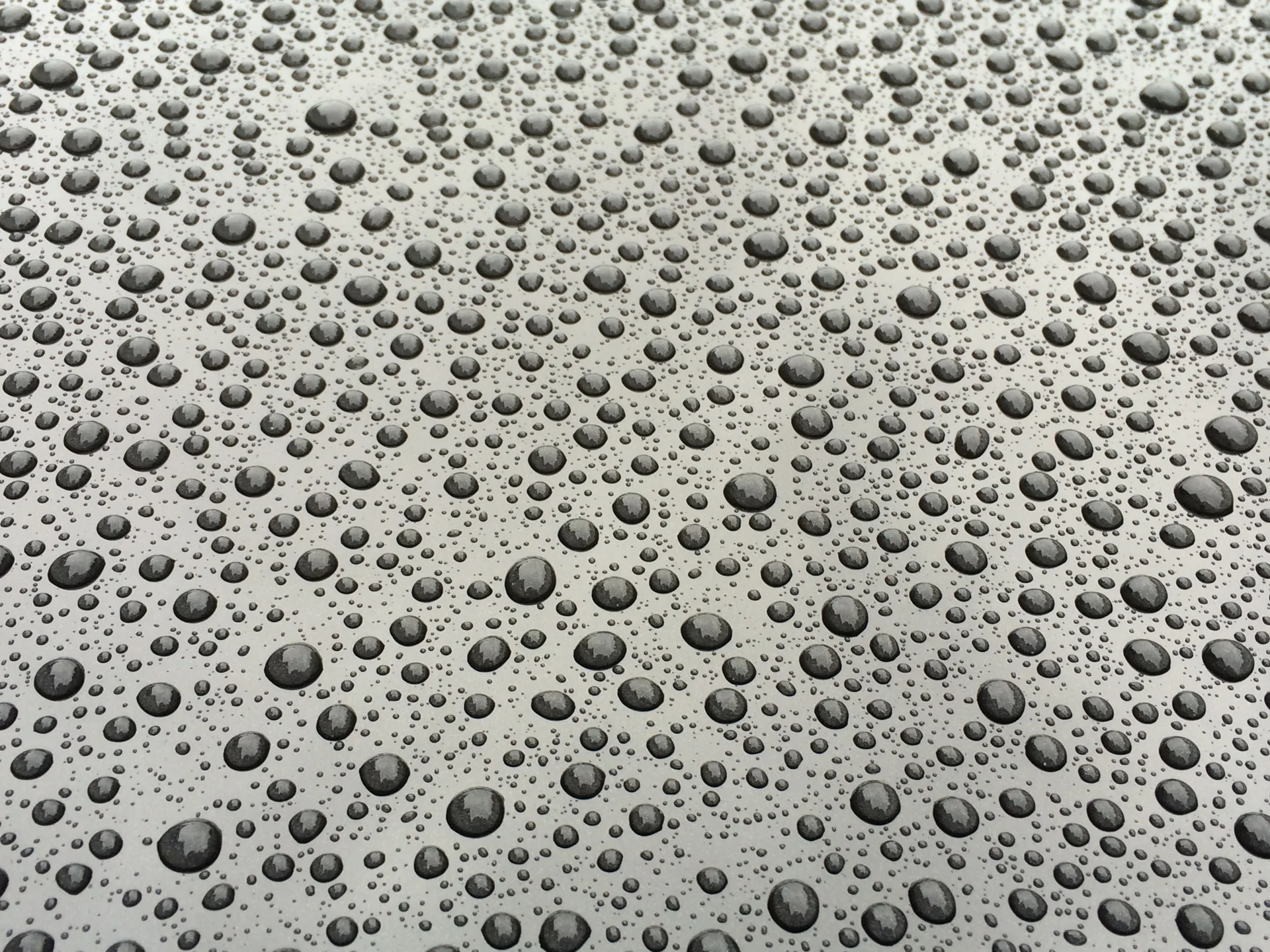
| Helps with | Bird droppings, insect residue, limescale and dirt – they are easier to remove | Stone chips, light scratches, wear on the loading sill or door handle cups |
| Does not help with | Stone chips, parking knocks, deeper scratches | Very hard impacts that penetrate the film. Even if the film holds, a stone chip can dent the paint underneath. |
| Thickness | Very thin, well below the clear coat thickness | According to manufacturers about 170–240 µm |
| Self-healing | No | Only to a very limited extent: fine, superficial scratches in the top layer, depending on the product with heat or at room temperature |
| Preparation | Thorough cleaning, paint correction if needed, degreasing | Thorough cleaning, paint correction if needed, precise cutting |
| Visibility | Not recognisable as a layer | With pre-cut templates, edges are visible on close inspection. With individual installation (custom-made), almost all corners and edges are wrapped – but this is not possible everywhere. |
| Effort and cost | Lower | Considerably higher and also considerably more expensive, depending on the scope |
How to tell what you need
First look at where your marks appear. Small dot-like impacts on the bonnet, bumper and mirrors point to stone chips. A grey haze, limescale spots or circular scratches in backlight point to care and environment. Then there is how you drive and wash: lots of motorway means more stone chips, and a brush car wash largely cancels out the advantages of any paint protection.
And neither ceramic nor film removes existing scratches. Both are applied to whatever condition is there at the time. How much work is involved overall therefore depends mainly on the paint condition and the scope – partial film on the front is something fundamentally different from a full wrap. For this reason we only quote fixed prices after an inspection.
Which solution suits which vehicle
Everyday car with normal mileage: a good hand wash and a sealant are often enough. Ceramic is worthwhile if easy care matters to you. Film is rarely necessary here.
High-end vehicle with lots of motorway driving: film on the front and heavily exposed areas, ceramic on the rest. With a smaller budget it is enough to film only the most exposed areas.
Seasonal vehicle with low mileage: careful care, possibly ceramic for easier cleaning. Film is often not worth it because of the low exposure.
Limited budget: improve the washing method first – it is a common cause of fine scratches. A regularly renewed sealant is then often the more sensible choice.
Often heard – is it true?
- “9H means the paint is scratch-proof.” Not quite. 9H is a result of the pencil hardness test according to ASTM D3363. It indicates which pencil lead no longer scratches the coating under laboratory conditions. It has nothing to do with the Mohs hardness of minerals, and it is no promise that wash scratches or a key will leave no marks.
- “Two or three layers of ceramic protect more than one.” It depends on the system. Some systems are designed as a build-up of base and top layer. With others, an additional layer brings no significant added value. Whether another layer makes sense can only be judged from the manufacturer’s information for the specific product – not across the board.
- “The film heals itself.” Only to a very limited extent. The top layer of many films can even out fine, superficial scratches – depending on the product with heat or at room temperature. Deeper scratches and impacts do not heal. Here the advertising promise is often bigger than the actual effect.
- “With film, the paint is 100 per cent protected.” No. Even if a stone chip does not penetrate the film, it can dent the paint underneath. A film reduces damage, but complete protection does not exist – you should let go of that idea.
- “With a ten-year warranty, the paint is covered.” Look closely. Manufacturer warranties on films – for example at XPEL – cover material defects such as yellowing, cracking, blistering or peeling. Stone chip damage and accident damage are generally not included.
My assessment from practice
For a normal everyday car I would not automatically recommend a full wrap. If you drive a lot on the motorway, film on the front is usually a very good choice.
And a ceramic coating does not make your paint stone-chip-proof – I would rather say that beforehand than have someone disappointed afterwards.
For ceramic, I generally only recommend systems that have proven themselves over many years. That is why we work with Gtechniq – not because we are accredited there, but because there are years of experience and reliably consistent results behind it.
How many layers make sense depends on the product. Among others, I work with Gtechniq Crystal Serum Ultra or Crystal Serum Light in combination with EXO V5. As a rule, two different coatings are applied: Crystal Serum as the base for long-term protection and chemical resistance, topped with EXO V5 as a top coat for better water and dirt repellency and a smoother surface.
Crystal Serum Ultra already forms a multi-layer structure with a single application. According to the manufacturer, further applications of the same product bring no relevant advantage. That is why I don’t think much of advertising five, seven or more layers across the board. What matters is the right preparation, the right system and professional application.
I don’t sell the highest possible number of layers, but a coating that makes sense for the vehicle and how it will be used.
Tom · Founder & owner of the GlanzSchmiede
Conclusion
Ceramic and PPF solve different problems. The right choice does not follow from the price or a package name, but from how you drive, how you care for your car and what your paint looks like today. Sometimes a combination makes sense; often less is enough than you might think.
Not sure what makes sense for your vehicle? Then let’s look at it together and discuss which options really match your expectations. Go to the contact page
Sources & further information
- XPEL – technical data sheet Ultimate Plus (film structure and thickness)
- SunTek – PPF Clear and Matte product information
- XPEL – FAQ and warranty coverage Ultimate Plus
- XPEL – Warranty Information
- Profilm PPF reGen – product information (thickness, self-healing without heat, Gtechniq compatibility)
- Profilm PPF Ultra Clear Pro – product information (self-healing with heat)
- Profilm PPF Ultra Clear Pro X – product information (239 µm)
Technical statements are based on these sources and have been summarised in our own words and cross-checked. Manufacturer information is identified as such. Personal assessments appear exclusively in the section “My assessment from practice”.
In this guide
- Two systems, two jobs
- How to tell what you need
- Which solution suits which vehicle
- Often heard – is it true?
- Conclusion
Personal advice
We look at your vehicle and tell you honestly what makes sense – and what does not.
Frequently asked questions
Your questions.
Can ceramic coating be applied to paint protection film?
Yes. There are coatings developed specifically for film surfaces. The film manufacturer Profilm, for example, names Gtechniq as a partner whose coating and care products are compatible with its films. Whether a particular combination is suitable should always be checked against the manufacturer’s information.
Can I have ceramic applied now and add film later?
That is possible, but it should be planned in advance. A ceramic coating makes it harder for film to adhere. If you plan to do both, the film is usually applied first and the coating afterwards.
Is paint protection still worthwhile on an older car?
That depends mainly on the paint condition and the remaining clear coat thickness. On older vehicles, moderate paint correction followed by a sealant is often more sensible than film.
Personal consultation
Your car.
Your standards.
Our advice.
Tell us what your car needs. We’ll get back to you personally – with a clear recommendation instead of an off-the-shelf package. We welcome clients from Aachen, the Eifel, South Limburg and East Belgium – and we reply in English or German.